
- Call Us: +91 70947 14455
- Email:hgwcin@gmail.com
Author
Syed Arif
When people talk about “the economy”, it often sounds cold and complicated: graphs, interest rates, inflation, GDP and the likes.
But in reality, the economy is very human, straight and easy to understand. It is about how we earn, how we spend, how we share, and how we treat each other with money.
The Qur’an gives a powerful picture in Surah Ibrahim, verses 24–26:
أَلَمْ تَرَ كَيْفَ ضَرَبَ ٱللَّهُ مَثَلًۭا كَلِمَةًۭ طَيِّبَةًۭ كَشَجَرَةٍۢ طَيِّبَةٍ أَصْلُهَا ثَابِتٌۭ وَفَرْعُهَا فِى ٱلسَّمَآءِ ٢٤
Do you not see how Allah compares a good word to a good tree? Its root is firm and its branches reach the sky,
تُؤْتِىٓ أُكُلَهَا كُلَّ حِينٍۭ بِإِذْنِ رَبِّهَا ۗ وَيَضْرِبُ ٱللَّهُ ٱلْأَمْثَالَ لِلنَّاسِ، لَعَلَّهُمْ يَتَذَكَّرُونَ ٢٥
Always yielding its fruit in every season by the Will of its Lord. This is how Allah sets forth parables for the people, so perhaps they will be mindful.
وَمَثَلُ كَلِمَةٍ خَبِيثَةٍۢ كَشَجَرَةٍ خَبِيثَةٍ ٱجْتُثَّتْ مِن فَوْقِ ٱلْأَرْضِ مَا لَهَا مِن قَرَارٍۢ ٢٦
And the parable of an evil word is that of an evil tree, uprooted from the earth, having no stability.
Allah is giving an example to help us understand the power of good and bad words. A good word—like sincere faith, truth, or kindness—is compared to a strong, healthy tree. Its roots are firmly fixed, so it stands solid, and its branches grow high into the sky. This tree keeps giving fruit all the time because Allah allows it to, just like how good words and good deeds keep bringing blessings and positive effects in a person’s life again and again.
On the other hand, an evil word—lies, disbelief, or harmful speech—is like a weak, rotten tree that has no stability. It can be pulled out of the ground easily because it has no firm roots. It can’t grow, give fruit, or benefit anyone. Even if it seems to be growing the roots are still feeble.
So Allah gives these examples to help people think, understand, and remember what is truly good and what is harmful.
What Scholars Say About Kalima Tayyiba in the above verses
Ibn Abbas (r.a.) said the “good word” is La ilaha illa Allah. The good tree is the believer deeply rooted with this word. Other scholars like Mujahid, Ikrimah, and Sa’id bin Jubayr (May Allah have Mercy upon them all) gave similar explanations. The evil word represents falsehood and corruption, like an uprooted tree.
This parable is usually explained about faith and belief. But it also gives us a deep way to think about the Good Economy vs. Bad Economy.
The parable of the good tree and the bad tree is mainly about faith, but it also gives a powerful way to think about how economies grow or collapse.
A good word—strong, sincere, and beneficial—is like a tree of good economy built on honesty, fairness, stable foundations, and productive work. Just like the good tree has deep roots, a healthy economy is rooted in trust, ethical business, transparency, and systems that allow people to grow. When these roots are strong, the “branches” of the economy—business growth, innovation, jobs, and community wellbeing—reach high and keep expanding. And just as the good tree gives fruit regularly with Allah’s permission, a good economy produces continuous benefits like stable incomes, opportunities, social harmony, and long-term prosperity.
On the other hand, an evil word—false, weak, and harmful—is like a tree of a corrupt economy built on corruption, exploitation, shortcuts, debt traps, and dishonesty. Its roots are shallow, meaning it has no real foundation. Such an economy might look fine for a short time, but it collapses easily—just like a weak tree that can be pulled out of the ground. A bad economy cannot produce stable benefits; whatever “fruit” it gives is temporary, unstable, and often damaging in the long run.
This is why Allah uses parables: so we can apply them not only to faith, but also to life, society, and the systems we build—reminding us that anything built on truth and goodness will grow, and anything built on weakness and deception will fail.
Linking Kalima Tayyiba to a Good Economy
A good economy is like a good tree.
Its roots are firm:
Built on truth, fairness, responsibility, compassion, trust, accountability.
A system with deep roots survives crises and remains stable.
Its trunk is strong:
A good economy has clear rules, transparent transactions, fair wages, shared risk, and value-based growth.
Its branches reach the sky:
A good economy uplifts families, supports communities, encourages innovation, and benefits even those who didn’t build it.
It gives fruit at all times:
A good economy continuously benefits society—stable families, strong communities, fair markets, dignity, hope, opportunities.
Linking Kalima Khabeetha to a Corrupt or Weak Economy
A bad economy is like a rotten tree.
No roots:
Based on greed, interest, exploitation, manipulation, dishonesty. No stability or ethics.
Easily uprooted:
Falls during crises—recession, inflation, market crashes—because injustice has no foundation.
No fruits:
Only benefits a few at the top. The common people get stress, debt, inequality, hopelessness.
No stability:
Shines temporarily but collapses over time.
In short:
A good economy is like the good tree—deeply rooted, steadily growing, and constantly producing benefits.
A bad economy is like the weak tree—unstable, easily destroyed, and unable to give real, lasting value.
“Allah destroys interest (Riba) and gives increase for charities (Sadaqah).”
The Qur’an says, “Allah destroys Riba and gives increase for Sadaqah.” This isn’t just a spiritual statement; it reveals how economies work. Riba (interest) creates a corrupt system where money grows without real effort, trapping people in debt and concentrating wealth in the hands of a few. Such an economy becomes fragile and unjust, like a tree with weak roots that cannot stand for long.
Meanwhile, Sadaqah (charity) lays the foundation for a good and healthy economy. It keeps wealth moving through society, supports the poor, reduces inequality, and builds trust and compassion between people. When charity becomes part of the economic culture, communities grow stronger and opportunities expand for everyone.
In essence, Riba weakens society, while Sadaqah strengthens it. One drains life from the economy; the other nourishes it with fairness, balance, and blessing.
Allah destroys Riba and increases Sadaqah. Riba creates inequality and debt slavery. Sadaqah circulates wealth, strengthens communities, and brings blessings.
Pillars of a Good Economy
1. Right foundation and accountability
A good economy is built on honest principles, ethical rules, and leaders who can be held accountable. Without a clean foundation, everything above it becomes unstable.
2. Justice and fairness in transactions
People should buy, sell, and deal with each other without cheating, exploitation, or hidden harm. Fairness ensures long-term stability and trust in the marketplace.
3. Real economy with real value
Growth must come from real work, real products, and real services—not artificial gains or debt-based bubbles. When value is genuine, prosperity is sustainable.
4. Circulation of wealth, not hoarding
Wealth should move through society so everyone benefits. When money is hoarded by a few, economic activity slows and inequality rises.
5. Trust, transparency, and strong institutions
Clear rules, honest systems, and reliable institutions make people feel secure. When trust exists, businesses grow, investments increase, and society thrives.
Roadmap to Establishing a Good Economy
1. Individual Level: Ethical Earning and Responsible Spending
People contribute to a stable economy by avoiding harmful or exploitative income sources, giving to social causes, and supporting businesses that follow ethical and sustainable practices.
2. Family Level: Financial Discipline and Debt-Free Living
Families strengthen the economic base by budgeting wisely, reducing dependence on high-interest loans, and teaching the next generation the values of honesty, saving, and social responsibility.
3. Business Level: Fair Practices and Value Creation
Businesses can drive economic growth by using partnership-based financing, paying fair wages, maintaining transparency, and focusing on real productivity instead of speculative gains.
4. Community Level: Grassroots Financial Support Systems
Interest-free loan groups, community cooperatives, and charitable endowment (waqf-style) projects can reduce local poverty, increase access to funds, and stimulate small-scale entrepreneurship.
5. Institutional Level: Interest-Free Banking and Financial Reform
Banks and financial institutions can adopt asset-backed financing, profit-sharing models, and Islamic finance principles to build a more stable and equitable system that avoids debt bubbles and economic exploitation.
Global Impact of a Good Economy
A good economy built on ethical and interest-free principles creates major positive effects worldwide. When nations reduce dependence on interest-based debt, they become more stable and less vulnerable to financial crises or debt traps. Asset-backed and responsible financing channels money into real production—jobs, industries, and infrastructure—rather than speculative bubbles.
As wealth circulates more fairly, global inequality decreases. Poor countries escape cycles of heavy debt, and richer nations gain long-term stability instead of short-term gains. This builds greater trust and cooperation between nations.
Interest-free models also reduce the risk of global financial crashes, since investments are tied to real value and shared risk. Markets become steadier, and economies grow on solid foundations.
Most importantly, such an economy restores human dignity: fewer people are trapped by debt, communities become stronger, and nations develop in a fair, sustainable, and humane way.
Closing Thoughts – The Tree We Choose to Grow
When we step back and look at the world, we realize something very important:
Economy is not just about money.
It is about values, choices, and consequences.
Every system grows from a belief.
Every structure begins with a mindset.
Every outcome starts with a foundation.
This is why the Qur’anic example is so powerful:
A good word creates a good tree.
A bad word creates a rotten tree.
In the same way:
A good mindset creates a good economy.
A corrupt mindset creates a harmful economy.
A Good Economydoes not start in banks or boardrooms.
It starts in the hearts of people
* People who believe wealth is a trust, not a weapon.
* People who earn with honesty, not exploitation.
* People who share, instead of hoarding.
* People who help, instead of taking advantage.
When these values take root, an entire society changes.
Just like a tree with deep roots stands firm in storms,
a good economy stands firm during crises — recession, inflation, uncertainty, fear.
It does not collapse because its strength comes from **justice, truth, and fairness**.
And just like a tree that gives fruit continuously,
a good economy keeps giving benefit:
* to the rich and the poor,
* to the strong and the weak,
* to today and tomorrow,
* to this generation and the next.
It produces dignity, not desperation.
It creates stability, not chaos.
It builds hope, not fear.
On the other hand, a corrupt economy — built on greed, interest, exploitation, and selfishness — may look fast, shiny, and profitable at first…
But it has no roots
It collapses easily.
It harms deeply.
It leaves people empty.
It divides society into two painful extremes:
A few drowning in luxury,
Many drowning in debt.
Such a system cannot last, because injustice cannot carry the weight of humanity.
And so, the real question is not:
How big is the economy?
How pure is its foundation?
Because growth without ethics is destruction in disguise.
Profit without fairness is loss in reality.
Wealth without compassion is poverty of the heart.
A Good Economy is not only about numbers going up —
it is about lives being lifted up.
It is about an environment where:
* The poor are not crushed.
* The middle class is not suffocated.
* The wealthy are responsible.
* The system is humane.
And the most beautiful truth is:
We don’t have to wait for governments to start it.
We can start it today — within ourselves.**
Every honest deal.
Every fair price.
Every interest-free help.
Every act of sadaqah.
Every ethical business decision.
All of these are like drops of water nurturing the **Good Tree of Economy**.
Maybe we cannot change the world overnight…
but we can plant something that will outlive us.
A system rooted in goodness,
grown with fairness,
and remembered for mercy.
Because in the end:
The true success of an economy is not measured by how much wealth it creates…
but by how many lives it heals.
May we be among those who plant, protect, and nourish the **Good Tree** —
so that its shade, its fruit, and its blessing reach far beyond us.
Ameen.
A good economy is the fruit of the good word—rooted in truth, built on justice, growing with compassion.
A corrupt economy is the fruit of the evil word—rootless, harmful, collapsing with time.
Every honest earning, every fair deal, every act of charity waters the good tree whose shade benefits generations.
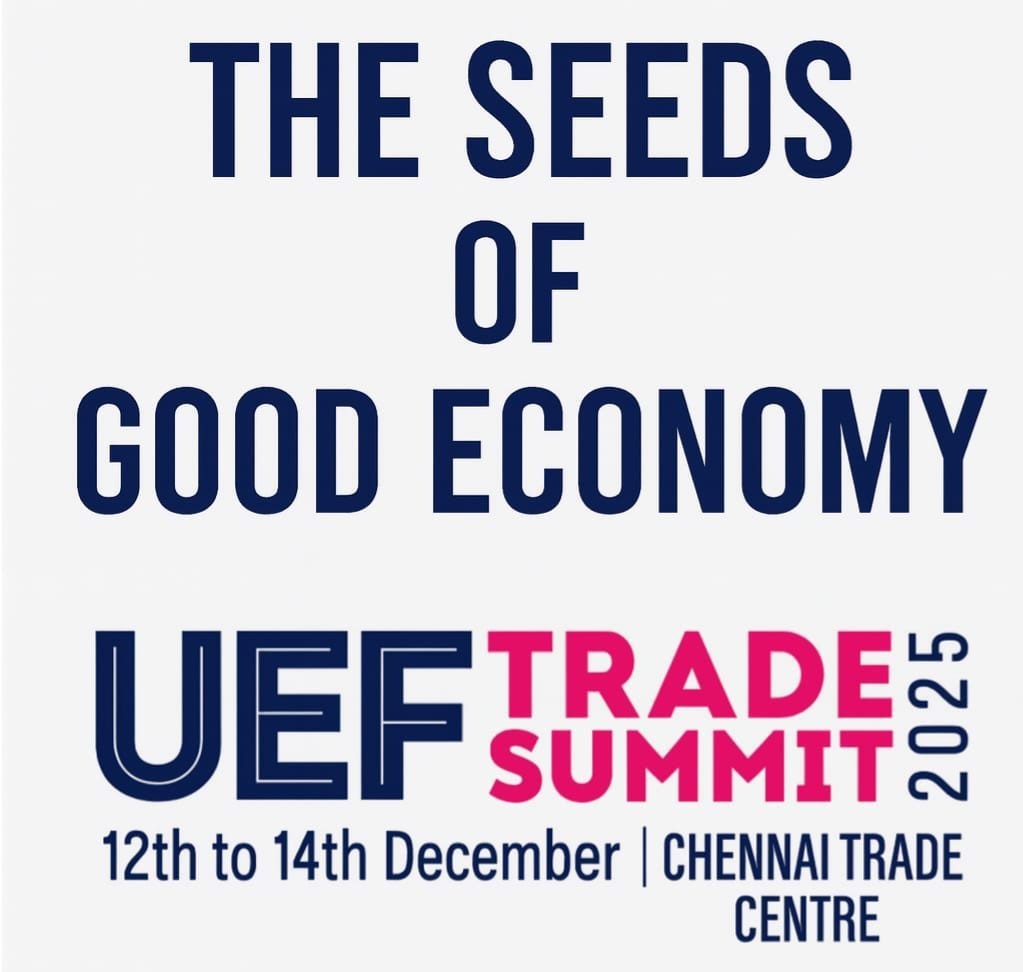
UEF Trade Summit 2025 – Planting the First Seeds of a Good Economy
Every great change begins with a single step.
Every strong tree begins with a tiny seed.
And when we talk about building a Good Economy—an economy rooted in fairness, ethics, opportunity, and shared growth—we need real platforms that turn ideas into action.
One such initiative is the:
✅ UEF Trade Summit – 2025
📅 12–14 December 2025
📍 Chennai Trade Centre
This summit is not just an event.
It is a starting point.
A foundation.
A seedbed for a new economic mindset.
A Summit Designed to Plant the Good Tree
Just like the Good Economy mirrors the good tree—with deep roots, strong growth, and continuous benefit—the UEF Trade Summit aims to:
Lay strong roots of ethical business networking
Build branches of collaboration across industries
Produce fruits in the form of opportunities, jobs, investments, and partnerships
It is a space where businesses, entrepreneurs, investors, and professionals come together not just to profit, but to progress together.
Planting Values, Not Just Deals
Unlike conventional trade events focused only on profit and competition, the UEF Trade Summit focuses on:
Honest trade
Fair growth
Ethical partnerships
Mutual benefit
Social upliftment
In other words:
This summit nurtures the roots of a Good Economy—not a greedy economy.
Empowering People, Not Just Corporates
UEF 2025 aims to:
Empower small and medium businesses
Support startups and new entrepreneurs
Connect job seekers with opportunities
Encourage skill development
Build bridges between communities
When people grow, the economy grows.
When businesses grow ethically, society becomes stronger.
A Platform That Circulates Benefit
At the heart of a Good Economy is circulation, not concentration.
This summit encourages:
Sharing knowledge
Sharing opportunities
Sharing resources
Sharing success
So that benefit doesn’t remain in a few hands, but spreads like the branches of a healthy tree.
🔗 Connecting Purpose With Prosperity
UEF 2025 is where:
Good intentions meet good opportunities
Ethical trade meets global exposure
Community values meet professional excellence
It proves that business can be profitable and principled at the same time.
A Launchpad for the Future
This summit is not just for three days.
It is the beginning of:
Long-term networks
Future collaborations
Sustainable ventures
Job creation
Community upliftment
Its impact will continue long after the event ends—like a tree that keeps giving fruit season after season.
A Step Toward a Better Tomorrow
If we want a world with:
Less exploitation
Less inequality
Less debt pressure
Less economic fear
Then we must build platforms that support fairness, transparency, and shared success.
UEF Trade Summit 2025 is one such platform.
✅ This Summit is a Seed.
✅ The Participants are the Gardeners.
✅ The Outcome is the Good Economy.
Together, we plant.
Together, we nurture.
Together, we grow.
And one day, the shade and fruit of this effort will benefit thousands—maybe millions.
This is how the Good Economy begins.
Not in theory—but in action.
An Article by
Syed Arif
Chairman – HGWC
UEF Trade Summit Registration – register now
For 50% discount- contact /whats app +919884484455
© Copyright 2024, All Rights Reserved
Leave Your Comments